
Why Homeowners Benefit From Knowing IICRC S500 Basics
When an independent restoration technician walks into your Shoreline home after a leak, you may hear phrases like "Category 2 loss," "Class 3 evaporation load," "LGR dehumidifier," or "grains per pound." That terminology is not arbitrary jargon—it comes from the ANSI/IICRC S500 Standard, the technical benchmark used by restoration professionals and insurance adjusters across Washington State to decide what can be dried in place, what must be removed for health safety, and when a structure is verifiably dry.
Understanding these categories helps homeowners across Richmond Beach, Innis Arden, Echo Lake, Ridgecrest, North City, Parkwood, and Briarcrest ask sharp questions during an on-site inspection and recognize why two seemingly similar puddles require very different drying scopes.
The Three Water Contamination Categories (1, 2 & 3)
| IICRC Category | Common Shoreline Sources | Health & Contamination Risk | Typical Material Handling |
|---|---|---|---|
| Category 1 (Clean Water) | Broken copper/PEX supply pipes, clean water heater rupture, overflowing bathroom sink or tub | Originates from a sanitary source; poses minimal initial health hazard if extracted quickly | Often allows in-place drying of carpets, framing, and sometimes solid hardwood when caught within 24–48 hours |
| Category 2 (Gray Water) | Washing machine overflow, dishwasher discharge, sump pump backup of clean drain water, toilet bowl overflow (urine only) | Contains significant chemical, biological, or detergent contamination that can cause discomfort or illness | Requires removal of porous carpet pad, cleaning/sanitization of hard surfaces, and careful moisture control |
| Category 3 (Black Water) | Sewage backups, toilet overflows with feces, overland stormwater flooding, groundwater seeping through soil/foundation walls | Grossly contaminated with pathogenic bacteria, fungi, or toxins; unsafe for direct contact | Requires containment, PPE, removal of soaked porous materials (carpet, pad, lower drywall, insulation), antimicrobial treatment, and HEPA filtration |
Critical Rule: Category Degradation Over Time
Water does not stay Category 1 forever. Under IICRC S500 principles, clean water from a burst pipe degrades into Category 2 or Category 3 if it sits stagnant for 48+ hours, flows across dirty garage floors, or picks up contaminants inside dusty wall cavities and crawlspaces. That is why calling for emergency water extraction on Day 1 can literally save thousands of dollars in demolition and reconstruction costs—see our Shoreline cost breakdown guide for a full comparison.
The Four Water Absorption Classes (Classes 1 Through 4)
While Category describes how dirty the water is, Class describes how much water is trapped in porous vs. low-porosity materials and how fast it will evaporate:
- Class 1 (Slowest Evaporation / Least Absorption): Affects only part of a room with low-porosity surfaces like bare concrete, vinyl, or sealed tile. Minimal moisture enters wall framing.
- Class 2 (Fast Evaporation / Significant Absorption): Affects an entire room of carpet and pad, with water wicking up drywall less than 24 inches and wetting structural framing along baseboards. Common in localized appliance leaks.
- Class 3 (Fastest Evaporation / Overhead Saturation): Water comes from overhead—such as an upstairs pipe rupture causing ceiling and drywall water damage—saturating ceilings, insulation, wall cavities, carpet, and subfloors simultaneously.
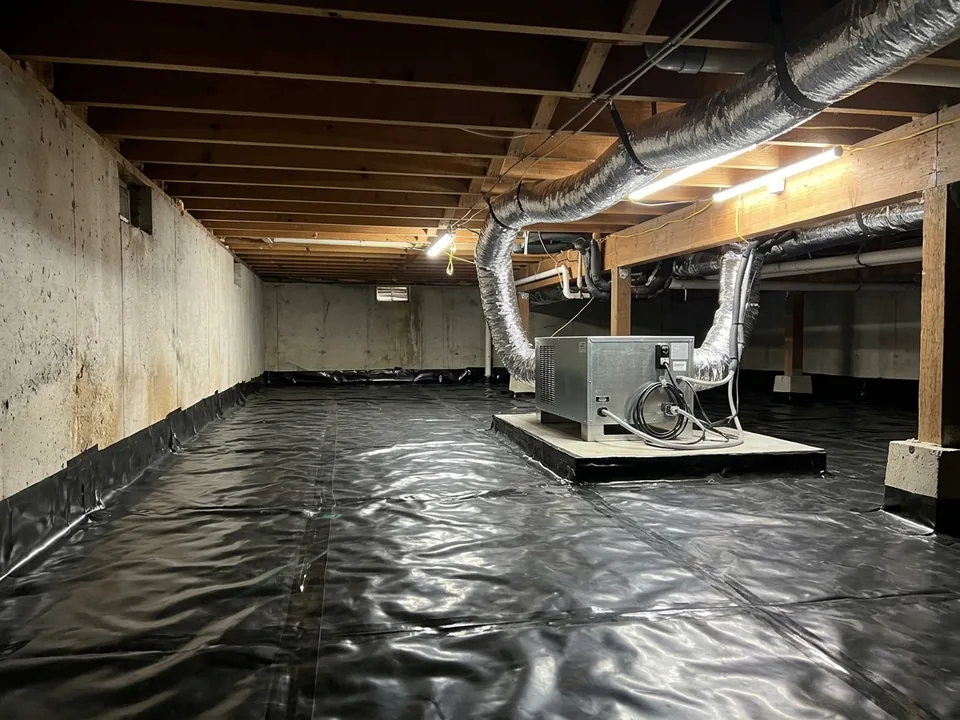
- Class 4 (Specialty Drying / Bound Moisture): Deeply bound water trapped inside low-permeance materials like solid oak hardwood flooring, concrete slabs, plaster walls, or crawlspace framing timbers. Class 4 losses require specialty equipment (floor drying mats, Injectidry cavity systems, and extended LGR dehumidification).
How Psychrometric Structural Drying Actually Works
Many homeowners assume drying a house is just about blowing air across wet carpet. In reality, structural drying and dehumidification relies on balancing four physical forces inside a closed drying chamber—especially crucial in Shoreline, where cool Puget Sound outdoor air regularly carries high relative humidity:
- Bulk Extraction First: Removing liquid water mechanically removes moisture far faster and more economically than trying to evaporate inches of standing water.
- Air Movement (Breaking the Boundary Layer): High-velocity axial and centrifugal air movers sweep away the thin, saturated layer of humid air clinging to wet drywall, concrete, and wood framing, accelerating evaporation into the room air.
- Dehumidification (Lowering Vapor Pressure): Commercial Low-Grain Refrigerant (LGR) dehumidifiers (such as Dri-Eaz or Phoenix units) pull evaporated moisture continuously out of the air and pump condensate down a drain. Lowering indoor grains per pound (GPP) creates a vapor-pressure gradient that pulls deeply bound moisture out of wood studs and subfloors.
- Temperature Control: Maintaining moderate, stable indoor warmth (typically 70°F–75°F) increases the air's moisture-holding capacity and speeds vapor movement without warping hardwood trim.
How Independent Technicians Verify Your Home Is Truly Dry
Drywall and wood framing can feel cool and dry to your bare hand while still holding 18% to 25% moisture content inside—plenty damp enough to support hidden mold growth once baseboards are nailed back on. Professional restoration technicians rely on calibrated instruments rather than touch:
- Infrared Thermal Imaging Cameras (e.g., FLIR): Detect subtle evaporative cooling patterns behind painted drywall and ceilings, revealing hidden wet pockets that the naked eye misses.
- Pinless (Non-Invasive) Moisture Meters (e.g., Tramex, Protimeter): Scan broad wall and floor surfaces quickly using radio-frequency signals without leaving pin holes in finished trim.
- Pin-Type Moisture Meters: Measure exact electrical resistance moisture percentage directly inside wood studs, sill plates, and subfloor decking.
- Thermo-Hygrometers: Track daily indoor temperature, relative humidity, and grains per pound (GPP) inside the drying chamber, outside the house, and at each dehumidifier's exhaust vent to confirm equipment is actively removing moisture.
Applying IICRC S500 Science to Shoreline Homes
Whether you are dealing with a Category 1 pipe leak in Echo Lake, a Category 3 flooded basement in Innis Arden, or a damp Class 4 crawlspace in North City, following methodical extraction, containment, and verified drying protects your home's structure and produces the exact documentation Washington insurance adjusters expect. Return to {BRAND}, explore our Shoreline Water Damage FAQ Hub, or call {PHONE_DISPLAY} 24/7 to connect with an independent local contractor.
A Real-World Shoreline Drying Timeline: Day 1 to Dry Verification
To see how IICRC S500 principles translate into daily field work inside a typical Shoreline home—say, a 1950s split-level in Parkwood or Ridgecrest hit by a sudden upstairs supply-line break—here is what a properly managed 4-day drying cycle looks like:
- Day 1 (Inspection, Extraction & Setup): The independent technician confirms safety, classifies the water (Category 1 clean), maps wet walls and ceilings with a FLIR thermal camera and pinless meter, extracts bulk standing water, pulls baseboards in affected rooms, sets containment sheeting, and positions commercial LGR dehumidifiers and axial air movers calibrated to room volume.
- Day 2 (First 24-Hour Psychrometric Check): The technician logs room temperature, relative humidity, and grains per pound (GPP), checks dehumidifier exhaust performance, and records pin-meter drops in bottom wall plates and subfloor joists. Air movers are repositioned if any corner pocket lags behind.
- Day 3 (Mid-Cycle Moisture Drop & Equipment Adjustment): As drywall and framing moisture fall rapidly toward baseline dry standards, technicians verify hidden cavities (behind cabinets or inside ceiling joist bays) and remove unneeded air movers from rooms that have already hit target readings.
- Day 4 (Dry-Standard Verification & Equipment Pull): Once pin and pinless moisture meters confirm all affected wood framing and drywall match the unaffected control readings established on Day 1, equipment is picked up and the homeowner receives the final drying log for their records or insurance adjuster.
Skipping daily monitoring or pulling dehumidifiers after 24 hours simply because carpet feels dry to the touch is the single most common cause of lingering musty odors and buckled flooring in Western Washington homes. Always insist on documented meter readings before closing up wall cavities or reinstalling trim. When you are ready to compare equipment requirements against estimated mitigation pricing, test your room dimensions in our Shoreline Water Damage Cost Calculator.
Frequently Asked Questions
How long does it take for Category 1 water to turn into Category 2 or 3?
Under typical indoor conditions, clean Category 1 water can degrade significantly within 24 to 48 hours as it contacts building materials, dust, and subfloor adhesives—especially in warm or humid rooms.
What is a normal dry-standard moisture reading for wood framing in Shoreline?
Technicians establish the exact dry standard by measuring unaffected framing or subfloor lumber in a dry part of your home. In Western Washington's marine climate, dry indoor wood framing typically sits around 9% to 13% moisture content.
Why do technicians measure grains per pound (GPP) instead of just relative humidity?
Relative humidity changes whenever room temperature fluctuates, whereas grains per pound measures the actual physical weight of water vapor in the air—giving technicians an accurate metric for dehumidifier performance.