
Why Water Damage Pricing Has Two Separate Phases
When Shoreline homeowners call for water damage restoration in Shoreline, WA after a sudden leak or storm flood, one of the first sources of confusion is the difference between mitigation and reconstruction. Understanding where one phase ends and the other begins helps you read independent contractor estimates accurately and communicate clearly with your insurance adjuster.
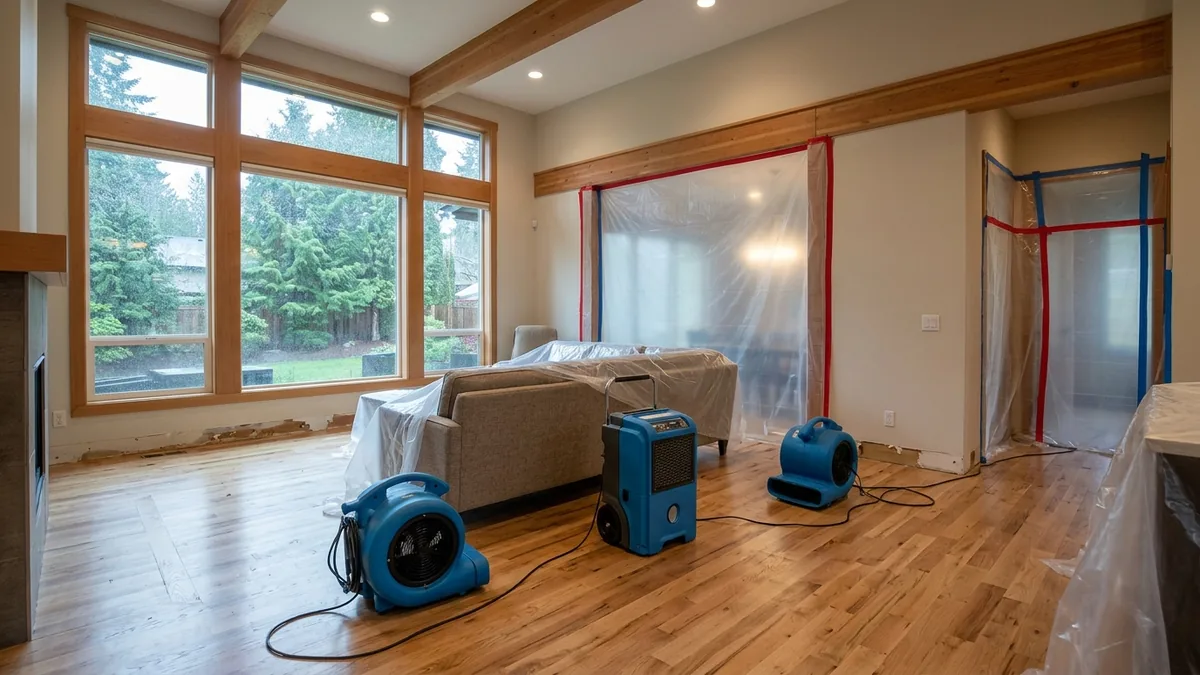
Phase 1 — Emergency Water Mitigation: Mitigation stops ongoing damage and stabilizes the building envelope. It covers initial moisture inspection with thermal imaging, emergency water extraction, removal of unsalvageable porous materials (such as soaked carpet pad, sagging drywall, or fallen crawlspace fiberglass), antimicrobial application where required by water category, and several days of commercial structural drying and dehumidification with daily psychrometric moisture logging.
Phase 2 — Reconstruction (Build-Back): Once calibrated moisture meters confirm that framing studs, sill plates, and subfloors have returned to dry-standard equilibrium, reconstruction replaces finished surfaces—hanging and taping new gypsum board, matching orange-peel or knockdown ceiling texture, installing baseboards, priming and painting, and replacing damaged flooring or cabinetry. Some independent contractors handle both phases under separate work authorizations, while others focus strictly on emergency mitigation.
Key Cost Drivers for Shoreline & North King County Properties
Because Shoreline sits in North King County with local labor rates, disposal fees, and damp coastal humidity, no two water losses price identically. Even two 300-square-foot floods on the same street in Richmond Beach or Parkwood can carry noticeably different scopes depending on what got wet and how long water sat before extraction started.
| Cost Factor | Lower-Scope Scenario | Higher-Scope Scenario | Why It Changes the Quote |
|---|---|---|---|
| Water Category (IICRC S500) | Category 1 clean supply-line leak caught within hours | Category 3 groundwater seepage or sewage backup | Category 3 requires PPE, containment barriers, negative air scrubbers, disposal of porous finishes, and thorough sanitization. |
| Affected Building Materials | Bare concrete basement slab or vinyl plank flooring | Solid oak hardwood, plaster walls, insulated exterior cavities | Dense hardwood and insulated cavities (Class 3 or 4 losses) require specialty mat systems, cavity injection, and extra LGR drying days. |
| Space & Accessibility | Open main-level hallway or garage | Tight 1950s vented crawlspace or multi-story ceiling chase | Low-clearance crawlspaces and overhead ceilings require additional setup labor, containment sheeting, and debris bagging. |
| Response Timing | Standard weekday daytime dispatch | 2:00 AM weekend or holiday storm surge | After-hours emergency mobilization often includes an emergency service call fee when crews deploy immediately overnight. |
| Drying Duration | 2–3 days for light surface wetting | 5–7+ days for saturated daylight basements in winter | Commercial LGR dehumidifiers and axial air movers are billed per unit per day, plus daily technician monitoring visits. |
How Line-Item Restoration Estimates Are Built (Xactimate Basics)
Most independent restoration contractors who work with Washington homeowners insurance carriers build their written scopes using standardized restoration pricing software (commonly Xactimate), which updates regional Seattle–King County labor and material rates monthly. Rather than guessing a lump sum, a transparent mitigation invoice breaks work into verifiable line items:
- Emergency Service Call & Moisture Inspection: Mobilization, initial safety assessment, thermal camera scanning, and establishing baseline dry standards in an unaffected room.
- Bulk Water Extraction (Per Square Foot): Priced differently for hard surfaces (tile/concrete) versus carpeted rooms requiring weighted extraction passes.
- Content Manipulation & Containment: Moving furniture out of wet rooms, placing foam blocks under wood legs, and hanging 6-mil polyethylene zipper barriers to isolate drying chambers.
- Selective Demolition & Haul-Off: Detaching baseboards, pulling saturated carpet pad, making clean 12-to-24-inch drywall flood cuts, and disposing of debris at King County transfer facilities.
- Equipment Rental & Daily Monitoring: Number of commercial LGR dehumidifiers, air movers, and HEPA air scrubbers multiplied by the verified number of drying days, plus daily moisture meter logging.
Want to test how square footage, water category, and flood cuts shift a ballpark planning range for your home? Use our interactive Shoreline Water Damage Cost Calculator before speaking with a contractor.
Room-by-Room Cost Patterns in Shoreline Neighborhoods
Finished Daylight Basements (Richmond Beach, Innis Arden & Parkwood)
Daylight basements are common across Innis Arden, Richmond Beach, and Parkwood. When winter groundwater enters through a foundation cove joint or failed sump pit, the water is classified as Category 3 due to soil contact. That means flooded basement cleanup typically involves pump-out, carpet pad disposal, baseboard removal, lower drywall flood cuts, concrete antimicrobial wash, and 4 to 6 days of heavy LGR dehumidification. Acting on Day 1 keeps the wet perimeter small before capillary action wicks water higher up interior partitions.
Post-War Rambler Crawlspaces (North City, Ridgecrest & Briarcrest)
In North City, Ridgecrest, and Briarcrest, many 1940s–1960s ramblers sit over shallow crawlspaces insulated with fiberglass batts. A hidden supply leak or winter runoff event triggers crawlspace water removal. The primary cost drivers below a house are standing-water depth, the labor required to pull and bag waterlogged fiberglass insulation from tight joist bays, replacing torn 6-mil black poly vapor barriers, and running compact horizontal dehumidifiers until Douglas fir floor joists drop below target moisture thresholds.
Multi-Story Pipe & Ceiling Leaks (Echo Lake & Infill Townhomes)
When an upstairs bathroom supply line bursts in an Echo Lake townhome or two-story residence, water migrates sideways along floor joists before saturating downstairs drywall. Scope combines burst pipe water damage mitigation with ceiling and drywall stabilization—requiring plastic containment over kitchens or living rooms, careful removal of compromised ceiling panels, and focused overhead airflow.
Do City of Shoreline Permits Add to Water Damage Repair Costs?
Permitting depends entirely on whether work stays within emergency mitigation and like-for-like cosmetic repair or crosses into structural, plumbing, electrical, or site drainage modifications. Under City of Shoreline Planning and Community Development guidelines, emergency drying and basic non-structural drywall replacement typically do not require a building permit. However, if water damage exposes rotted structural joists requiring framing repair, or if you decide to repipe aging galvanized lines, relocate walls, or install new exterior stormwater drainage systems, City of Shoreline building, plumbing, or site development permits (and Washington State L&I electrical permits for electrical alterations) will apply. Always confirm permit requirements with your independent licensed contractor before authorizing structural rebuild work.
How to Avoid Overpaying Without Cutting Corners on Drying
- Act Immediately to Shrink the Footprint: Waiting 48 hours turns a localized Category 1 leak into a multi-room Category 2 or mold-risk loss—often doubling or tripling total cost.
- Ask for Written Scope & Moisture Logs: Reputable independent contractors measure and show you meter readings at setup and daily check-ins, justifying exactly how many air movers and dehumidifiers are needed.
- Verify Licensing & Insurance Upfront: Before signing a work authorization, verify the independent contractor's Washington State L&I registration and liability coverage.
- Coordinate Early With Your Insurance Carrier: If the loss stems from a sudden indoor plumbing failure, review our Washington Homeowners Insurance & Water Damage Claims Guide so you preserve every photo and receipt your adjuster needs.
When to Call for an On-Site Evaluation in Shoreline
Online calculators and cost guides help you plan, but only physical moisture meter readings and thermal imaging reveal how far water has traveled behind cabinets or beneath subfloors. Call {BRAND} at {PHONE_DISPLAY} 24/7 to connect directly with an independent local Shoreline water damage contractor who can inspect your property and provide an on-site scope.
Comparing Self-Pay vs. Insurance Billing on Shoreline Mitigation Jobs
Homeowners in Shoreline frequently ask whether mitigation pricing changes depending on how the invoice is paid. Independent restoration contractors calculate equipment, labor, and disposal using the same physical measurements either way, but administrative documentation differs. Insurance-billed jobs require daily psychrometric drying charts, digital sketch floor plans, and line-item Xactimate scopes formatted for carrier review. Self-pay jobs on smaller, localized clean-water events—such as a single wet hallway closet in North City or a minor utility-room leak in Briarcrest—sometimes allow homeowners to limit optional finish demolition if moisture meter readings show framing can be dried safely in place.
Before authorizing work, ask the independent contractor three straightforward pricing questions: (1) What is the estimated equipment count and daily drying window based on today's meter readings? (2) Are after-hours dispatch fees or disposal charges itemized separately? (3) Will you provide a written scope change before removing any cabinetry, tile, or hardwood flooring?
Frequently Asked Questions
Why can't a restoration contractor give an exact price over the phone?
Water travels invisibly underneath flooring and inside insulated wall cavities. Until a technician inspects the area with moisture meters and thermal imaging to determine square footage, water category, and demolition needs, any phone quote is only a rough range.
Is emergency water extraction cheaper if I pay out of pocket instead of using insurance?
Independent contractors set their own pricing policies. For small, localized clean-water leaks near or below your policy deductible, some homeowners choose to pay directly to avoid filing a claim—discuss self-pay scope options directly with the independent contractor during inspection.
Does running dehumidifiers for 4 days add a lot to my Seattle City Light bill?
Commercial LGR dehumidifiers and air movers draw steady electricity while running continuously. While the added utility cost is modest compared to replacing warped subfloors, keep your utility bill if you are filing a covered insurance claim, as some adjusters reimburse documented drying power.